Expanding the core

Dave McLeish
September 18, 2026

The job of fixed income is relatively simple: provide income, diversification and resilience when the rest of a portfolio is under pressure. This raises an important question for New Zealand investors – can a market as small and concentrated as our local bond market fulfil that role?
In fixed income, you win by avoiding losses.
That’s because, the upside from a bond is inherently limited to the income you were promised, plus any gain from falling yields or tightening credit spreads. While the downside can be far more significant if credit quality deteriorates or liquidity disappears.
That asymmetry makes diversification particularly important. Otherwise a single issuer, sector or economic outcome can pose a far larger risk to your portfolio, than it should.
The New Zealand fixed income market is undoubtedly high-quality. Its problem is scale.
As measured by the Bloomberg NZBond Composite 0+ Yr Index, the domestic market sits at just $266bn – with an overwhelming $193bn concentrated in AAA-rated NZ Government debt.
Total issuers 47
Global issuers / diversifiers 15
Government market share 73%
Non-government market value $73bn
Source: Bloomberg, Wedge
That degree of extreme concentration limits the diversification available to investors.
In a market with so few issuers, limited offshore exposure, sporadic issuance, minimal securitisation and shallow secondary-market liquidity, a domestic-only bond fund simply does not have the tools available to manage these risks appropriately.
The challenge for New Zealand fixed income isn't quality. It's diversification.
Australia: Depth in every dimension
Across the Tasman, the fixed income landscape operates on an entirely different scale.
Here the equivalent Bloomberg AusBond Composite 0+ Yr Index spans a vastly broader universe of semi-government, supranational, financial, corporate, and securitised debt.
Total issuers 240
Global issuers / diversifiers 123
Government market share 45%
Non-government market value (NZD) $1.2tn
Source: Bloomberg, Wedge
At NZ$2.3 trillion, using the current exchange rate, the Australian bond market is almost nine times the size of New Zealand's. A structural difference that has widened meaningfully since 2020.
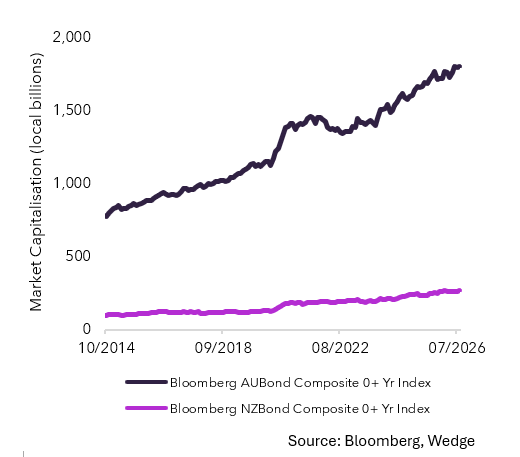
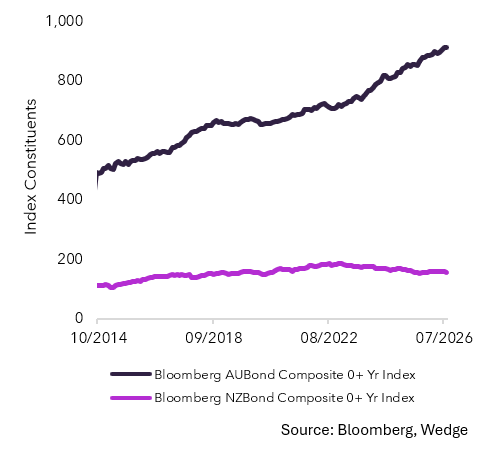
Security count tells a similar story. Whilethe AusBond Index has over 900 individual securities, the NZBond Index has less than 160 – a number lower now than it was four years ago.
For investors, the additional market depth that an allocation to Australia can provide matters because it provides:
· Broader issuer diversification,reducing single-borrower credit risk;
· Greater exposure to different economic and market drivers; and
· Superior secondary-market liquidity, providing more flexibility to a adjust portfolio when markets become volatile.
This scale is a source of choice. Indefensive portfolios, choice is an important form of risk management.
As total KiwiSaver assets surpass $150bn, the amount of capital seeking exposure to domestic fixed income continues to grow.
KiwiSaver schemes currently hold roughly $30bn of domestic cash and fixed income assets. While NZ Government debt provides baseline interest rate exposure and sovereign protection, active managers intentionally seek out high-grade, non-sovereign bonds to enhance yield and build credit diversification.
However, market size is now a core constraint.
When removing sovereign debt, and the investable universe shrinks to a mere $73bn.
Therefore, even on the assumption that only half of KiwiSaver's domestic income allocation is invested in non-government bonds, that represents a significant 20% of that entire market.
Layer on the demand from bank treasury desks, other managed funds, retail investors and offshore investors, and it’s easy to see why most high-grade, non-government bonds are routinely impossible to source in the secondary-market.
The consequences of this are structural:
Demand for high-quality domestic bondscan mean managers repeatedly allocate to the same small group of issuers.
When demand consistently exceeds available supply, credit spreads can become compressed – reducing the compensation investors receive for taking credit risk.
When market stress hits, liquidity often becomes severely constrained. With many domestic managers holding similar securities and facing similar redemption pressures, they can all tend to be looking to sell at the same time.
For a defensive asset class, that can directly undermine portfolio resilience when it matters most.
This is where a trans-Tasman approach becomes interesting.
It provides a materially broader opportunity set without the sweeping complexities of a fully global fixed income mandate.
What’s more, despite their geographical proximity, the Australian and New Zealand economies clearly don’t move in lockstep. Economic cycles, inflation dynamics and monetary-policy settings often diverge – creating different sources of risk and return within the same regional allocation.
When these two markets respond differently to economic or global shocks, this where a portfolio can benefit from having exposure to both markets. Providing an additional layer of protection while retaining the familiarity of two developed, closely connected markets.
When a market is small and concentrated, diversification has natural limits.
There is another reason to question a purely domestic bond allocation.
Diversification should not be considered asset class by asset class. It should be considered across an investor's total wealth.
Most New Zealand investors already carry substantial exposure to the domestic economy through their primary residence, equity holdings, businesses, and salaries. Stacking a domestic-only bond fund on top of that simply reinforces rather than reduces that concentration.
Instead, an Australasian allocation to bonds can serve as a valuable pressure valve – reducing asset correlation while preserving a high-quality defensive allocation.
Of course, the objective is not to abandon New Zealand. It's to avoid asking one very small market to do too much of the diversification work.
For New Zealand investors, the question is whether an anchor bond allocation should stop at the border.
At Wedge, we believe there is strong rationale for replacing the traditional New Zealand-only allocation for a trans-Tasman one.
It retains the familiarity and defensive characteristics expected of a bond portfolio while adding a much broader pool of issuers, securities, liquidity and economic exposures.
For a defensive asset class, the objective is to build resilience. Greater diversification within a deep, well understood market like Australia can significantly reduce concentration and liquidity risk – which ultimately reduces the risk of loss.
After all, that’s what bonds are there to do.
This document does not constitute financial advice. The information has been prepared with reasonable care and is believed to be accurate at the date of publication. No representation or warranty is given as to its accuracy, completeness or currency, and neither the author nor Wedge accepts liability for any loss arising from reliance on the information, except to the extent that such liability cannot lawfully be excluded or limited.
Welcome to Wedge. And welcome to reaching your savings goals faster.



.png)